
What Happens Between Harvest and Your Kitchen?

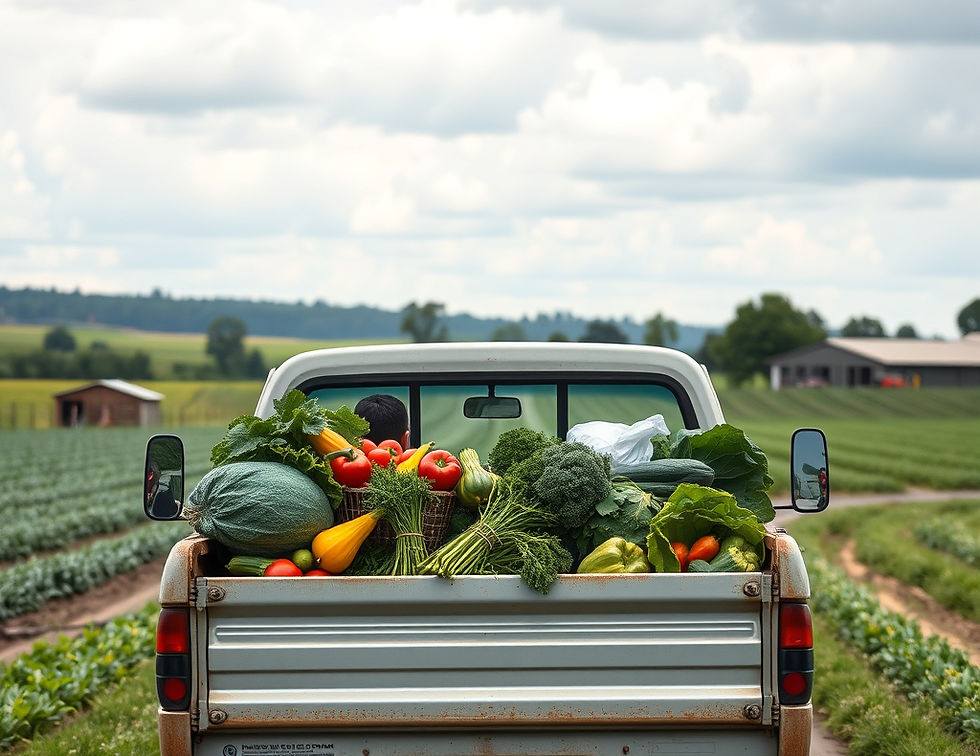
The journey of your food matters, too.
When we think about fresh produce, we usually think about where it was grown.
But there’s another question worth asking:
What happened to your food after it was harvested?
For much of the produce sold through conventional grocery supply chains, the harvest isn't the end of the journey. It may be only the beginning. Produce can move through packing facilities, distributors, warehouses, trucks, distribution centers and retail stores before eventually reaching your refrigerator. That system makes it possible to feed millions of people year-round. But it also means that the journey between farm and table can be surprisingly complicated. At Crop Stop Farm, we're interested in making that journey much shorter.
Harvest Day Looks Different on a Small Farm
One of the advantages of growing on a small, local scale is that there aren't many places for our produce to go. For our locally grown offerings, the journey can be remarkably simple:
Crop Stop Farm → Harvest → Customer
That's it.
When we prepare produce for a Crop Stop order or farmers market, we're harvesting for our neighbors. That changes the relationship between farmer, food, and customer.
Fewer Miles. Fewer Hand-Offs.
Think about a head of lettuce for a moment. In a large supply chain, that lettuce may be harvested alongside thousands of others, packed, transported, distributed and eventually placed on a grocery-store shelf. By the time you purchase it, you may know the brand printed on the package.
But do you know the farm?
How far it traveled?
Who handled it along the way?
Those aren't questions most of us were taught to ask. Maybe they should be.
Buying directly from a local farmer doesn't eliminate the need for good food-safety practices. Every grower, large or small, has a responsibility to handle food carefully.
What a shorter supply chain can provide is something else:
visibility and traceability.
You can ask questions. You can learn how your food is grown. And you can know who is responsible for it.
The Shortest Supply Chain Might Be Your Backyard
And there's an even shorter food journey than buying from Crop Stop.
Growing something yourself.
A pot of basil on the windowsill counts.
So does a tomato plant on the patio.
So does sharing zucchini as the neighbor who grows too much of it every summer.
We don't believe supporting local farms and growing your own food are competing ideas. We think they're part of the same one. A more resilient local food system can include backyard gardeners, community gardens, small farms, larger regional farms and neighbors sharing what they grow.
Food security starts with community.
This Week at Crop Stop
🌱 Available again starting August 22, 2026: our CSA Boxes 🛒 Shop here starting August 16.

📍 Next Farmers Markets
Friday September 4, 2026 3-7PM— Parsippany, NJ (Smith Field Park)
Friday September 11, 2026; 3-7PM— Parsippany, NJ (Smith Field Park)


Comments